The 10 Best Studio Monitors List for 2025
Achieving professional-level mixes requires accurate and reliable studio monitors. As technology evolves, the options for studio monitors continue to improve, offering exceptional audio quality and precise sound reproduction.
This article has compiled a list of the 11 best studio monitors for mixing in 2025. Whether you're a seasoned audio engineer or a home studio enthusiast, these monitors will take your mixing experience to the next level.
Mid 2025 Update: I just updated this list to have more options for studio monitors at various price points covering entry, mid and high level budgets.
1. Neumann KH 310A

Specifications:
Frequency response: 34 Hz to 21 kHz (± 3 dB)
Total amplifier power (tri-amplified): ~290 W RMS (with 150 W LF, 70 W mid, 70 W HF)
Maximum SPL: up to ~116.3 dB SPL
Cons:
The price is prohibitively high for most enthusiasts
Pros:
amazingly accurate and neutral sound:
Wide, controlled sound dispersion
Tight, clean bass and strong transient response
WHY I RECOMMEND IT:
The Neumann KH 310A is a premium three-way active studio monitor, setting the standard for precision and accuracy in audio monitoring. Engineered with meticulous attention to detail, these speakers utilize advanced acoustic technology to deliver an unparalleled listening experience.
The coaxial design integrates a unique Mathematically Modeled Dispersion™ (MMD™) waveguide, ensuring optimal dispersion and phase coherence. The high-performance drivers and powerful amplifiers provide an exceptional transient response and a wide dynamic range.
The KH 310A's robust construction and flexible control options make it ideal for professional recording, mixing, and mastering environments, guaranteeing uncompromising audio quality for critical listening applications.
2. KEF LS50 META

Specifications:
Frequency response / range: –6 dB at 47 Hz–45 kHz; —3 dB at 79 Hz–28 kHz
Recommended amplifier power: 40–100 W per channel
Maximum output: up to 106 dB SPL
Pros:
Exceptional clarity and detail
Stylish modern design
Balanced and versatile performance
Cons:
Require a good amplifier and careful setup
Not ideal for very large rooms
WHY I RECOMMEND IT:
The KEF LS50 Meta is a high-performance bookshelf speaker that redefines audio excellence. The features that make it so good at music reproduction are what make it one of the best studio monitors. Combining cutting-edge technology and sophisticated design, these speakers deliver an immersive sound experience with exceptional clarity and depth.
The innovative Metamaterial Absorption Technology eliminates distortion and diffraction, allowing the Uni-Q driver to produce an accurate, coherent soundstage. The speaker's rigid cabinet construction and port design optimize bass response while reducing resonance.
With a sleek and elegant appearance, the LS50 Meta complements any decor. Ideal for audiophiles and music enthusiasts, these speakers offer remarkable audio performance, making them a standout choice in high-end audio.
3. Klipsch R-51PM

Specifications:
Frequency response: 68 Hz – 21 kHz
Bass extension (dynamic): down to ~49 Hz at lower volumes.
Built-in amplifier: 60 W per channel (120 W total)
Maximum output (SPL): ≈ 107.3 dB
Pros:
Dependable, inexpensive speakers punching above their price point.
Stylish design
Balanced and versatile performance
Cons:
No crossover control
WHY I RECOMMEND IT:
The Klipsch R-51PM earns a spot on our recommended list because it delivers big, room-filling sound in a compact, hassle-free package. The built-in amplification is a major advantage, giving you a clean, dynamic presentation without needing a receiver or extra gear.
Klipsch’s signature horn-loaded tweeter brings impressive clarity and detail, especially in vocals and upper frequencies, while the 5.25-inch woofer provides punchy, controlled bass that feels larger than the cabinet suggests. For listeners who want lively, energetic sound with real volume capability and modern convenience, the R-51PM is one of the best value powered bookshelf speakers available and a favourite with people looking to set up home studios on a budget.
4. Kanto TUK

Specifications:
Drivers: 28 mm × 35 mm AMT tweeters + 5.25″ aluminum woofers
Amplifier: Built-in Class-D amp, rated 260 W peak (≈130 W total RMS)
Frequency response: 50 Hz – 20 kHz
Inputs: Bluetooth 4.2 (aptX HD & AAC), USB DAC, optical (TOSLINK), RCA, dedicated phono-preamp RCA
Pros:
Exceptional clarity and detail
Fully active setup with great connectivity
AMT tweeters provide great high-end performance
Cons:
Require a good amplifier and careful setup
Not ideal for very large rooms
WHY I RECOMMEND IT:
TUK stands out as a full-featured, all-in-one powered speaker system that punches well above its size class. Its 5.25″ aluminum woofers and Air Motion Transformer (AMT) tweeters deliver detailed, dynamic sound with clean highs and surprisingly solid low-end for a bookshelf design.
The built-in 130 W RMS Class-D amp and DSP tuning mean no extra amplification is required due to the active design. I really rate the connectivity options Kanto gives us with plug-in via Bluetooth (aptX HD / AAC), USB, optical, RCA, or even a turntable (via the dedicated phono input). Choose your source, and away you go.
On top of that, features like a sub-out with selectable crossover, headphone output, custom EQ presets, and auto power-on/off add flexibility for desktop setups, vinyl rigs, or compact home theaters. It’s a workhorse monitor set, but with the versatility and robustness to handle multiple roles for a high end home setup.
This is the one I'd go for if I didn’t want the hassle of multiple components and the setup involved with it. The AMT tweeter stands out, giving detail-rich and composed highs that were really the stand out feature for me.
4. Adam Audio A7V

Specifications:
Drivers: 7″ MLM woofer + X-ART ribbon tweeter with HPS-waveguide
Frequency response: –6 dB at 40 Hz – 45 kHz; –3 dB at ~44 Hz – 41 kHz
Amplifier power (built-in): Woofer ~ 90 W RMS / 110 W peak; Tweeter ~ 15 W RMS / 20 W peak
Pros:
Very accurate, balanced tone across the spectrum a characteristic of ribbon speakers
Gets super loud without distortion
Super versatile, also great for watching movies
Cons:
If you are unfamiliar with ribbon speakers, you need to give yourself time to adjust “brain burn” to their characteristics - it might sound odd at first, but perceive and in a few hours you’ll get it
WHY I RECOMMEND IT:
The Adam Audio A7V is a professional-grade active studio monitor designed for critical audio monitoring and mixing tasks. Equipped with advanced technology, these speakers deliver exceptional precision and clarity across the entire frequency spectrum.
The innovative ART (Accelerating Ribbon Technology) tweeter ensures accurate high-frequency reproduction, while the mid-woofer guarantees a tight and punchy bass response. The A7V's built-in amplification offers high power and low distortion, providing a robust and detailed sound experience. Its compact and sleek design makes it suitable for various studio setups.
These studio monitors are a top choice for professionals seeking accuracy, transparency, and reliability in their audio production work.
5. Yamaha HS8

Specifications:
8″ cone woofer + 1″ dome tweeter, 2-way bi-amped active monitor
Frequency response: ~ 38 Hz – 30 kHz (-10 dB)
Built-in amplification: total 120 W (75 W for woofer + 45 W for tweeter), with balanced XLR and TRS inputs.
Pros:
Very flat, neutral sound
undistorted even at high volumes
Comes with room‑adjustment controls
Cons:
Overwhelming in small spaces
Cold sound is for music production and monitoring, not versatile for a do everything speaker
WHY I RECOMMEND IT:
I recommend the HS8 because it struck me as a no-nonsense, honest-sounding monitor — nothing is “flattering,” just clean, accurate playback that reveals exactly what’s in the recording. The deep 8″ woofer gives real low-end weight (down to around 38 Hz), and the clarity from the tweeter means even subtle details stay intact. Because it’s bi-amped and powered, it’s super convenient: plug in an audio interface or mixer, and you’re ready, no separate amp needed.
For mixing or serious listening, the HS8 feels trustworthy — what you hear is what’s there, not what’s been “enhanced.”
6. Dynaudio LYD 48

Specifications:
Active 3-way monitor: 8″ woofer, 4″ midrange, and 1″ soft-dome tweeter with Class-D amplification (80 W woofer / 50 W mid / 50 W tweeter).
Frequency response (-6 dB, with bass-extension option): down to ~ 40 Hz up to ~ 21 kHz
Maximum SPL (pair at 1 m): ~ 112 dB.
Pros:
Individually amplified monitors
Studio-grade performance
Powerful enough to present well in large spaces
Cons:
Its expensive
Too big for small room setups - you could but its overkill
WHY I RECOMMEND IT:
The Dynaudio LYD 48 is a flagship 3-way studio monitor designed for uncompromising audio accuracy and control. Equipped with proprietary MSP (Magnesium Silicate Polymer) drivers and a unique dual-bass port design delivers outstanding clarity and precise low-end reproduction.
The intuitive DSP (Digital Signal Processing) offers user-selectable sound tailoring, allowing for easy room integration and adjustments to individual preferences. The LYD 48's advanced Class-D amplification ensures optimal performance and low distortion.
With its elegant and robust design, this studio monitor is a top choice for audio professionals seeking a powerful, versatile, and transparent sound solution, making it suitable for mixing, mastering, and critical listening tasks.
7. JBL Professional 708P

Specifications:
Frequency response: ~ 45 Hz – 23 kHz (±1.5 dB), full range 35 Hz – 36 kHz
Amplification: Built‑in dual Class‑D amps — 250 W for woofer + 250 W for tweeter
Maximum peak SPL: > 114 dB (at 1 m)
Pros:
Class-leading performance under 1000
Reference-grade sound
Reliable like no other, JBL have refined this over the years and it shows
Cons:
Kind of industrial looking, functional and not stylish
Kind of big and impossing in small spaces
WHY I RECOMMEND IT:
The JBL 708P is a high-performance 8-inch bi-amplified studio monitor that sets the standard for precise audio reproduction. It features JBL's patented Image Control Waveguide technology, ensuring accurate sound dispersion and sweet spot expansion.
The 2409H high-frequency transducer and 728G low-frequency transducer, powered by dedicated Class-D amplifiers, deliver exceptional clarity and deep bass response. The sophisticated DSP offers room EQ and alignment adjustments, ensuring optimal performance in various studio environments.
The rugged and compact design makes the 708P suitable for near-field and main monitoring applications, making it an excellent choice for recording studios, post-production suites, and broadcast facilities.
8. KRK V8 S4
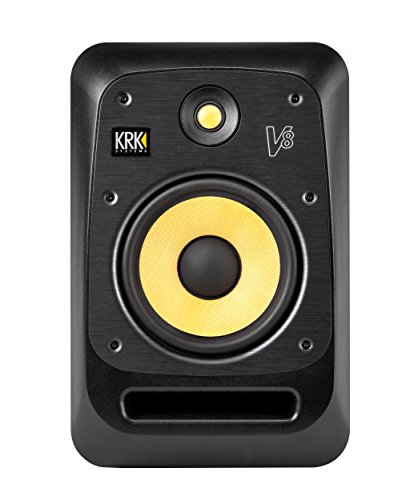
Specifications:
8″ Kevlar‑cone woofer + 1″ Kevlar‑dome tweeter, bi‑amped active 2‑way studio monitor
Frequency response: 35 Hz – 19 kHz (±3 dB), with extended range down to 29 Hz and up to 24 kHz (–10 dB)
Amplification & output: 200 W for woofer + 30 W for tweeter (230 W total), with a maximum peak SPL around 118 dB.
Pros:
Reference grade sound
Looks funky and is really well made
Very spacious sounding with very low distortion
Cons:
It’s a great performer but a little pricey, look for discounts off the full RRP
Limited in-store availability makes it a blind buy for most
WHY I RECOMMEND IT:
The KRK V8 S4 is a professional-grade 8-inch 3-way studio monitor engineered to deliver unparalleled accuracy and precision in audio monitoring.
Equipped with a powerful Kevlar woofer, a Kevlar midrange driver, and a titanium dome tweeter, it ensures pristine sound reproduction across the entire frequency spectrum. The rear panel features a 3D-Axis Iso-Mount for versatile positioning and optimal acoustic alignment. The built-in Class-D amplification offers high headroom and low distortion, enabling the V8 S4 to handle complex audio easily.
Ideally suited for critical listening, mixing, and mastering tasks, this monitor embodies KRK's commitment to superior sound quality and reliable performance.
9. Presonus Sceptre S8
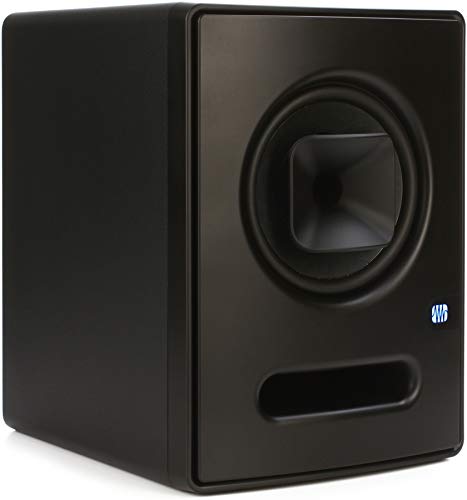
Specifications:
Active 2‑way monitor with 8″ glass‑reinforced paper woofer + 1″ horn‑loaded compression tweeter, bi‑amped with ~ 180 W RMS Class‑D amplification (≈ 90 W per driver)
Frequency response: about 46 Hz–20 kHz (–3 dB), extending to ~ 38 Hz–23 kHz (–10 dB)
Maximum peak SPL: ~ 116 dB at 1 meter
Pros:
Delivers a wall of sound effect, very impactful at near range
Symplistic and modern design, and very well made
Bass is surprisingly deep, meaning a separate sub might not be necessary in all cases
Cons:
Don’t even think about it for desktop setups, it’s big, and so is the sound. I wouldn’t want to be sitting with my face next to this one.
WHY I RECOMMEND IT:
The PreSonus Sceptre S8 is an exceptional 2-way active studio monitor renowned for its innovative coaxial transducer design and advanced DSP processing.
The 8-inch LF and 1-inch HF compression drivers are precisely aligned to ensure a coherent point source audio dispersion, yielding outstanding stereo imaging and accuracy. The CoActual technology minimizes phase issues, reproducing precise sound with reduced comb filtering effects.
Equipped with powerful DSP filters, acoustic space tuning, and high-pass filters, the Sceptre S8 adapts to various room environments. The robust build, impressive SPL capabilities, and transparent sound make it a top choice for professionals in recording, mixing, and mastering.
10. PreSonus Eris E3.5

Specifications:
3.5″ Kevlar‑cone woofer + 1″ silk‑dome tweeter, active 2‑way monitor with built‑in amplifier (~25 W per speaker)
Frequency response: 80 Hz – 20 kHz
Maximum peak SPL: ~ 100 dB @ 1 meter
Pros:
Cheap but well made
Good for desktop setups
Front facing controls
Cons:
Lacks refinement and power of other speakers on the list, but at its current price is the best option for someone getting started on a budget
WHY I RECOMMEND IT:
The PreSonus Eris E3.5 is a compact, budget-friendly 3.5" nearfield studio monitor with impressive audio performance. A woven composite woofer and silk dome tweeter produce clear and accurate sound across the frequency range. The front-firing bass port reduces port noise and enhances low-end response.
The rear panel features convenient input options, including a balanced 1/4" TRS, unbalanced RCA, and an auxiliary input for connecting smartphones or other devices.
The volume and high-frequency adjustment controls also allow users to tailor the sound to their environment. Ideal for home studios and multimedia applications, the Eris E3.5 offers excellent value for its price.
Conclusion:
Selecting the right studio monitors is crucial for achieving accurate and detailed mixes. The 10 monitors above represent the best options for mixing in 2025 catering to various budgets and studio requirements.
Whether you're a seasoned professional or a passionate home studio enthusiast, investing in these top-tier monitors will enhance your mixing experience and help you create outstanding audio productions.